Trauma Therapy for First Responders: Sarah Farnaby ’99 and Bruce the Therapy Dog
Written by Chris Worthy
First responders often meet people who are experiencing their worst day. Healthcare providers, fire fighters, law enforcement and others who run to help will see tragedy and pain – it comes with the job. But where do the helpers go when the crisis is over and the trauma remains?
Sarah Farnaby, PsyD, LPC, LCPC, ’99 is part of the solution. She is co-president of OTR Wellness Counseling and Support Services, a District of Columbia-area nonprofit organization that provides trauma-related and wellness supportive services to clients without financial barriers. The counseling practice specializes in working with survivors of trauma and crisis response.
Farnaby and the OTR Wellness team were honored recently with the Chief’s Recognition Award from the Metropolitan Washington Airports Authority Police Department for their work in the aftermath of a catastrophic collision at Ronald Reagan National Airport on January 29, 2025, that resulted in the deaths of 67 people. During the days-long aftermath, Farnaby and her team provided constant support to first responders. And that continues even now.
Charting Her Path at Converse
Farnaby earned her bachelor’s degree in psychology at Converse, and went on to earn a master’s in Counseling Psychology in 2001, and then a doctorate in Clinical Psychology in 2016. Even in high school, she knew what she wanted to do. At Converse, she found an environment that helped her achieve it.
“I graduated with a group of very strong women who all mostly are in leadership positions.”
Sarah Farnaby ’99
“I graduated with a group of very strong women who all mostly are in leadership positions,” Farnaby said.
Her path was set early in her Converse experience, working with children in crisis, both in Spartanburg and when she returned home to Myrtle Beach.
Supporting Others Through Difficulty
“By the time I got to Boston and I got my master’s, I was working in a residential treatment center with adolescent girls,” she said. “You start getting involved with the helpers more and more.”
That experience continued through Farnaby’s work with the Center for Children in Maryland, the Wendt Center For Loss and Healing, and House of Ruth, a domestic violence agency in Washington, D.C.
“I started to work with people that were in difficult situations, that were coming there because it was a very confidential environment and they were also in the federal government or they were some type of first responder,” she said. “I went back to get my doctorate, and finished that in 2016, and with that, I was able to push my education specifically toward forensic and first responders.”
Focusing on First Responders
Farnaby started her practice with her business partner, Jennifer Fuentes, in 2008.
“We just started getting more and more people that were helpers, that includes nurses, the first responder umbrella – police, fire, dispatch, clinical social workers that work with child advocacy, federal law enforcement. We have people from all the different departments and federal agencies that come in. We also work with humanitarians who come from conflict zones. We often take on journalists from conflict zones. And then we see military,” she said.
OTR now has offices in Virginia and in Washington, D.C. “There’s never enough people that specialize in working with first responders. It takes years of seasoning, but most important, you have to really build those relationships and that trust,” Farnaby said.
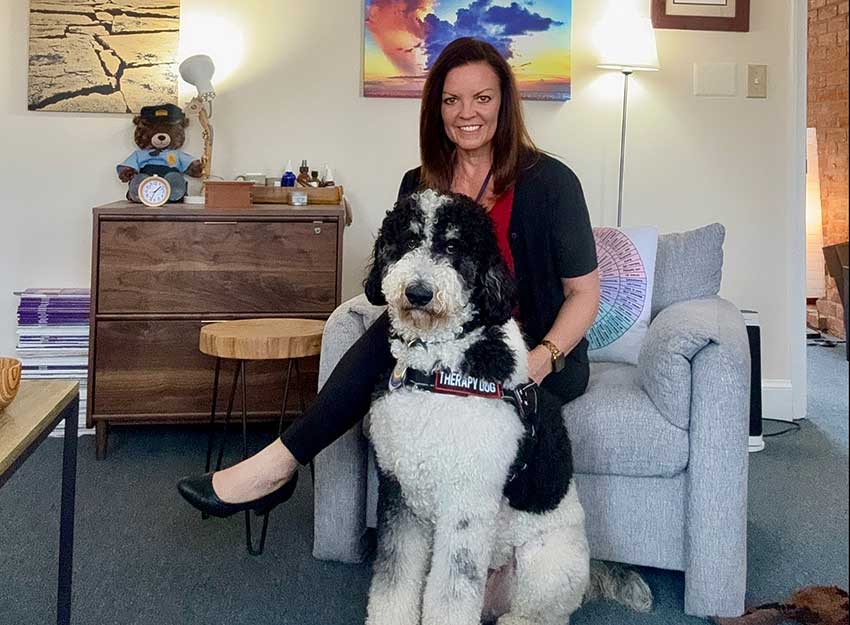
That takes time, commitment and the ability to meet people where they are. OTR now has a walk-in wellness program for those helpers and their families. And Farnaby can often be found on site with her sidekick, Bruce, a two-year-old Bernedoodle therapy dog who is even better than Farnaby at breaking through to those who could use some support. The pair regularly attends roll calls with law enforcement as officers start their shift and prepare for the hours ahead.
Help from a Four-Legged Friend
“I’ll go to a roll call, and I’ll bring Bruce, and he brings those stress hormones down,” she said. “The impact on their mental health is significant, and until recently, there was so much stigma. It wasn’t normal to get help. It wasn’t normal to have therapists involved.”
“You see the change in someone when they have that moment… He’s in all my therapy sessions.”
Sarah Farnaby ’99
But attending to the mental health of first responders is critical – for them, for their families and for their communities. Working with peer support teams and debriefing following incidents is how Farnaby “ended up at the airport.” She and her clinical team were on site with first responder peer teams after the January 29, 2025, disaster. They arrived as quickly as they could access the site and stayed all night assisting multiple agencies. Many of the first responders could only compare it to the aftermath of 9/11.

“Some of them saw the worst they’ve ever seen in their life and in their career,” Farnaby said. “It took their breath away, and they did their job, but it was nothing they could have ever, ever predicted they would have to deal with in their career.”
Some pulled Farnaby aside to talk. Others needed a moment to interact with Bruce. Soon, peer teams and other therapy dogs were on site, all working together to help the helpers.
“They were exhausted and just numb and traumatized. And if Bruce was in the station, they would start playing with him, and for five minutes they’d have a laugh and a smile and they wouldn’t be there. They would have that moment to kind of refuel that oxytocin and take a break from those terrible, terrible few days. It works. You see the change in someone when they have that moment. He really makes a huge difference. He’s in all my therapy sessions,” she said.
Building Brighter Futures
Farnaby said she was determined to go beyond what she had been told she was capable of as a high school student – working, leading and caring for people who help carry the load of their neighbors. Converse helped a “pretty stubborn” young woman create her own path to an exceptional life’s work.
“I never, ever would have thought in my entire career that I would face an incident like the DCA collision – ever – and just come up with a plan and what to do,” she said. “Can I do this and how do I do it? I’m beyond anything I ever thought that I’d be doing.”
Helping the helpers is a mission that can lead to ripples of wellness far beyond what happens in the immediate crisis first responders face.
“When somebody is scared, they need to feel safe, and they need to feel comfort,” Farnaby said.
Steady, stigma-free, accessible support can make all the difference. And a wag from Bruce doesn’t hurt.
Learn more and support OTR Wellness at overtherainbowllc.com.