Experiential Learning for Community Impact: Converse University & Teachers Up
Written by Chris Worthy
Apprenticeship Program Puts Education Students in the Classroom
In elementary school, Carlee Turner ’29, spent hours after school participating in a Kids Upstate Kids Club. She never imagined that her second year at Converse University would bring that experience full circle.
Practical – and paid – experience that provides experiential learning and course credit while also serving the community will put Converse students, including Turner, on the leading edge of pre-service education for future teachers starting this fall.
It’s a natural partnership and one that aims to elevate purposeful collaboration on behalf of future educators and the youngest Spartanburg residents.
“Beginning in Fall 2026, our education majors will complete more than 120 hours of direct experience within an outcomes-focused, comprehensive after-school program.”
President Boone J. Hopkins
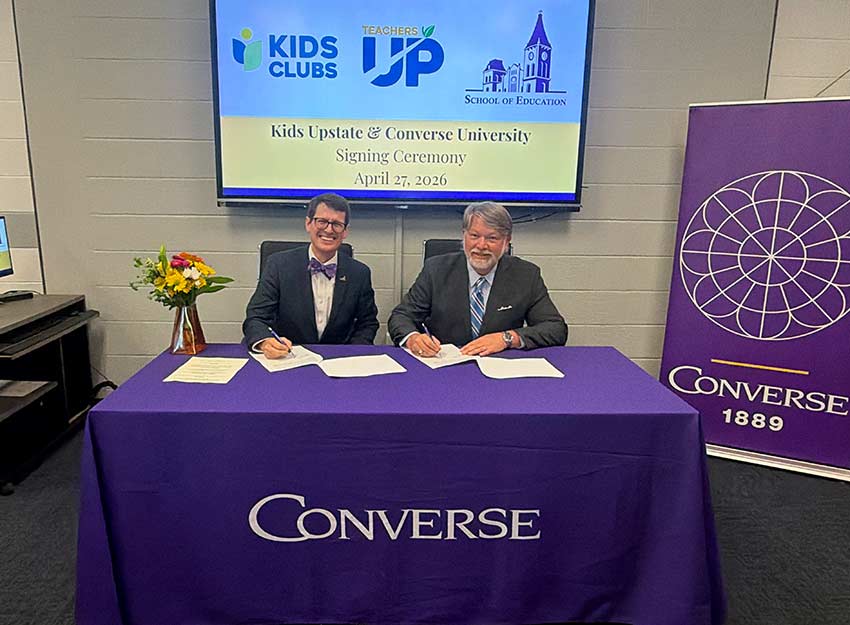
The Teachers Up Apprenticeship program, in partnership with Kids Upstate, will connect Converse University education students to paid work that will get them in the classroom where they can transform their own learning from theory to practice. At the April 27 signing of the partnership agreement, Converse President Dr. Boone Hopkins said the year-long, immersive experience blends academic preparation with meaningful, hands-on work in the community.
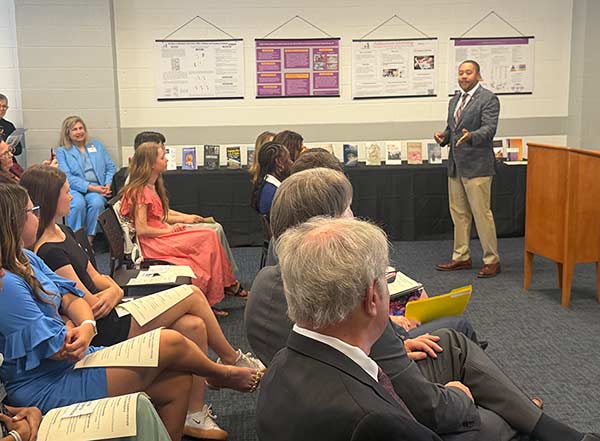
“Beginning in Fall 2026, our education majors will complete more than 120 hours of direct experience within an outcomes-focused, comprehensive after-school program,” Hopkins said at the signing event. “Serving in Kids Clubs in Spartanburg and Cherokee counties, our undergraduates will be building meaningful relationships with students while learning how to lead, how to adapt, and how to inspire. And perhaps what will make this opportunity even more special is that they will do so while earning a paycheck. They will also be earning college credit through our CON 214 course designed to connect academic study to these types of hands-on experiences.”
Greg Tolbert, President of Kids Upstate, said education apprentices will earn $17 an hour, “earning and learning – real experiences with elementary school students – a true pre-teaching opportunity to build classroom skills, classroom management, mentoring, while teaching through our standards-aligned Kids Up activities every day, covering leadership, education, arts and fitness.”
Building on Collaboration
Dr. JJ Lies, Assistant Professor of Education and Chair of the Department of Education, said the Teachers Up program creates a mutual benefit for Converse students and the participants in Kids Upstate programs. Tolbert reached out to Lies last winter, building on their previous relationship with an idea that resulted in the apprenticeship agreement. A handful of Converse students have been employed in Kids Upstate’s after-school programs but without the benefit of course credit or a formal connection between the university and the organization.
“Now can we open the door to give more access to students, to work directly with the youth in a way that they’re interested in, working as early as their first year in an after-school program that has a developed curriculum”
Dr. JJ Lies
“We started developing our partnership with Kids Upstate two years ago, and there was a natural synergy that revolved around doing what we could to serve the students in both K12 and higher education settings,” Lies said. “I love the idea. I thought it was a unique opportunity. So many other majors and career paths in higher education have paid internships. Somehow, education is one of the few where that isn’t the case. With student teaching, for example, you get to do it, and you get the opportunity to be grateful for it, but you don’t get compensation.”
Students who plan to become certified classroom teachers also have the responsibility of licensure expenses, including fingerprinting and testing fees, which can amount to $800 or more. Serving as a paid apprentice not only addresses that potential financial barrier, but it also provides experiential learning for education majors as early as their first year at Converse.
“Now can we open the door to give more access to students, to work directly with the youth in a way that they’re interested in, working as early as their first year in an after-school program that has a developed curriculum,” Lies said.
From Student to Teacher
Turner was a Kids Club participant throughout elementary school, and because her mother was a teacher and she was at school in the afternoons, she began volunteering with the program in sixth grade. She also volunteered in high school, but her career plan was to become a doctor, not a teacher.
“For the longest time, I actually fought it,” she said. “But I was working with Kids Club, and then I was a Teacher Cadet in high school.”
The experiences changed her perspective and she began to see herself in the role of educator.
“Once I stepped into a classroom, I was very passionate about teaching,” she said.
Turner said she can hardly wait to return to Kids Club this fall – this time, with an entirely new perspective.
“Just the fact that I get to go back and be a part of it, get to see kids and actually be in the schools again, really makes me excited,” she said.
A “Win-win” for All
Lies said the partnership is a benefit to the students of all ages, as well as the entities they represent. Converse students gain experience, earn course credit and financial compensation, even as they lay the foundation for their future career. And children in the Kids Upstate after-school program are led by future educators who are passionate about the opportunity. Bringing the idea to fruition has been made possible by a shared commitment, including by other Converse faculty members who restructured class times and worked to make the participation possible. Lies said recent discussions about the program within the Department of Education demonstrate that a new chapter is coming.
“They actually get to apply and bring in their experience now from these opportunities and it becomes real. It brings learning to life in a new way.”
Dr. JJ Lies
“Professors are talking about how excited the students are, how the students keep talking about it, and how this opportunity is going to provide another layer of understanding for students to contextualize the conversations in the classrooms and bring them to life,” Lies said. “It’s not just reading about theories in a textbook or discussing them. They actually get to apply and bring in their experience now from these opportunities and it becomes real. It brings learning to life in a new way.”