Knowledge Alchemy: Interdisciplinary Courses Expand Horizons & Inspire Lifelong Learning
Written by Chris Worthy
Pottery and chemistry? Biology and poetry? They go together like peanut butter and jelly – or maybe math and democracy.
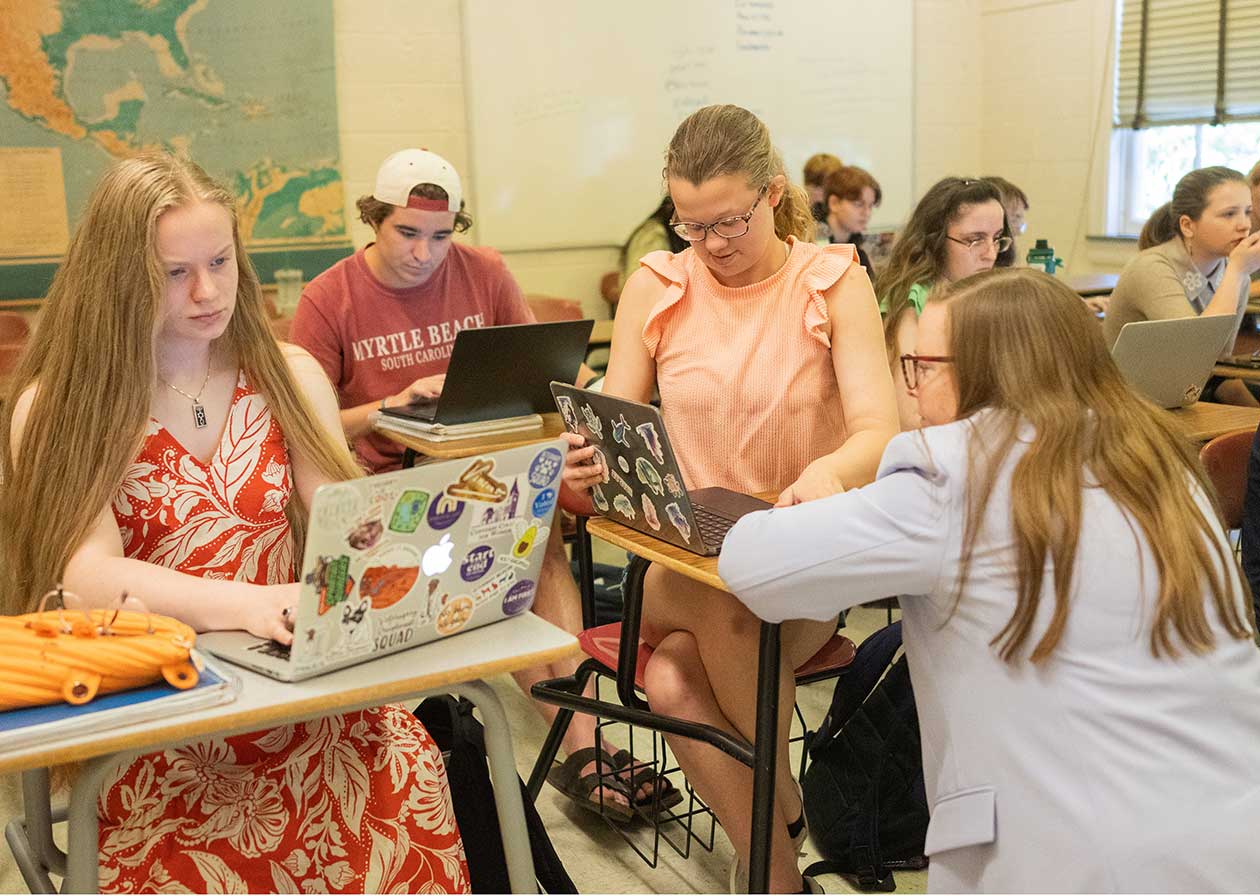
When students and faculty members blend ideas, mix disciplines and explore possibilities, the result can be an alchemy that is greater than the sum of its parts. Converse University’s interdisciplinary courses and honors seminars are unique experiences that reach across departments and combine interesting, thought-provoking approaches that create something entirely new.
Learning – and Teaching – Together
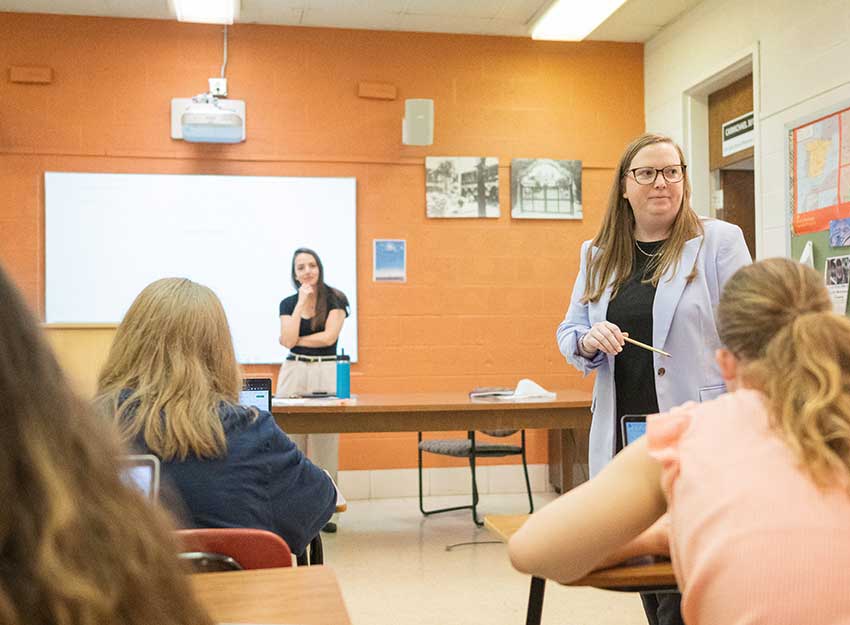
Dr. Laura Brown, Professor of English, Director of Arts and Humanities and Nisbet Honors Program Co-Director, is among those who lead team-taught courses, including Chem-Mystery, an interdisciplinary English and Chemistry honors course she taught in her role as Professor of English. The topics matter, but the lessons go beyond the subjects included, encouraging students to think beyond what they see.
“We all have something to learn and we all have something to share.”
Dr. Laura Brown
“I have really enjoyed getting to know some of my colleagues better by team teaching with them,” Brown said. “And one of the things that I think is beautiful about that experience is that it models for the student lifetime learning, because here we are teachers, but we’re learning alongside them – I’m taking notes during the chemistry section, and my colleague in chemistry is listening and reading the book along with the students. So, we’re all learning together. We all have something to learn and we all have something to share. And I think that’s very positive.”
Dr. Edward Woodfin, George Dean Johnson Jr., Chair of History and Nisbet Honors Program Co-Director, said he is sometimes the “matchmaker” for ideas and faculty members as they create these unique courses. He said many of the combinations get started over a lunchtime conversation between colleagues who are excited about an idea.
“I think the secret sauce of this for Converse is the fact that we are in a wonderful position to have interconnectedness,” he said.
Faculty members know each other and they communicate.
“That’s why they start over the table at Gee Cafeteria, because they are already friends and know each other,” he said. “Someone will start talking about something that they’re interested in, and then someone else will say, ‘Well, I do that too, except that my take on it is this,’ and by the time you’re done with it, you’ve got a class that emerges from it.”
Woodfin points to one course that combined pottery and chemistry, taking diverging disciplines in the same direction.
“Both art students and science students have mentioned to me how the exposure to the other half of that course was the thing that they really remembered from it,” he said. “The art students talked about how much they learned about the chemistry of the art that they had been making when they threw a pot. And then the chemists were fascinated to see how they can work with the chemistry to make something beautiful.”
Asking Questions and Combining Expertise
Dr. Allison Vick, Assistant Professor of Political Science, is co-teaching a math and political science course with Dr. Jessica Sorrells, Dean of the School of Business and Data Science and Associate Professor of Mathematics. The course, Math on the Ballot: Voting & Strategy, explores computational aspects of democracy.
“We were talking about how we’re from completely different disciplines, but we have quite a bit of overlap in some cases that people don’t tend to expect from either math or politics,” Vick said. “We started having conversations about all the different things that we see overlapping. We want to have a chance to talk through all these things – like representative democracy and what it looks like in a spatial model and data analysis and visualization – so that’s how we started, just with conversations of how our research overlaps. It turned into the kind of class we want to teach.”
Vick said the course has given her the chance to learn something new as she teaches with her colleague.
“I have the chance to learn just as much as our students do about how math seeds all of these different areas,” she said. “We were hoping this would be the right call for an interdisciplinary course – a chance for us to each talk about how we see the world through the lens of politics or math, and all the ways that we can learn from each other and understand our content areas even better.”
Cultivating a Love of Learning That Lasts a Lifetime
The courses teach far more than what is on the syllabus. Each gives students a window into how to explore ideas and connections throughout life.
“It’s a goal of higher education to give you breadth in the way that you see the world,” Woodfin said. “People join these classes partly because they’re thinking of it from one of the two angles – and then the thing that they find special about the class is the opposite angle.”
A new way of seeing the world can extend to lifelong learning and create excitement about the prospect of discovery.
“The interdisciplinary course forces you into thinking about how maybe we’re a little bit more connected than you think we are.”
Dr. Allison Vick
“The interdisciplinary course forces you into thinking about how maybe we’re a little bit more connected than you think we are,” Vick says. “Students also make real world connections, as well as connections between their courses. They start thinking about that, not just in the class they’re taking, but all of their classes. That’s how we learn.
“How do we connect things to what we already know, and how do we build off of that knowledge? That opportunity starts making us think of not just learning for the purpose of learning, but how to bring all of this together in a way that makes sense and encourages us to ask questions or be curious and learn something new.”