Math and Democracy: Finding the Common Denominator
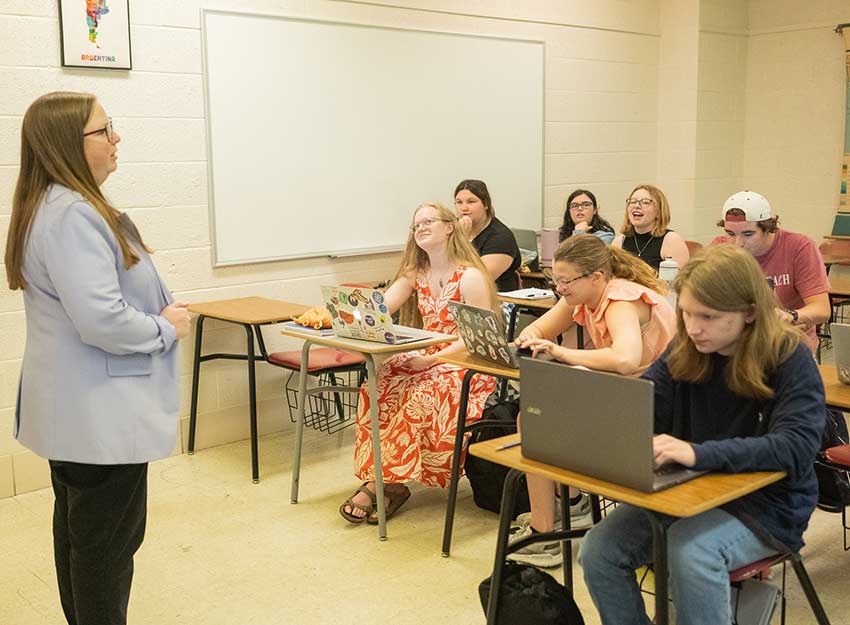
Converse University’s interdisciplinary courses and honors seminars are unique experiences that reach across departments and combine interesting, thought-provoking approaches that create something entirely new.
This spring, Dr. Allison Vick, Assistant Professor of Political Science, co-taught a math and political science course with Dr. Jessica Sorrells, Dean of the School of Business and Data Science and Associate Professor of Mathematics. Their course, ‘Math on the Ballot: Voting & Strategy’, explored computational aspects of democracy.
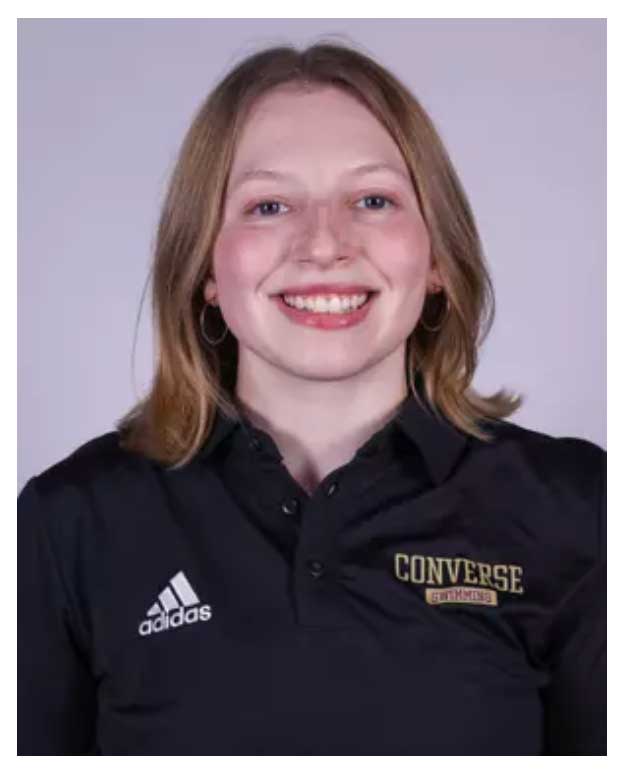
Nisbet Honors student Marie Durflinger ’26 shares the impact this course has made on her educational experience at Converse.
Math on the Ballot has quickly become one of my favorite classes I’ve ever taken at Converse. When it was announced that Dr. Vick would be teaching an honors course, I immediately knew it would be the first class I would sign up for. An honors course taught by one of my favorite professors was simply an opportunity I couldn’t pass up, especially since I’m graduating this year.
‘Math on The Ballot’ is the most cohesive interdisciplinary course I’ve ever taken.”
Marie Durflinger ’26 (Nisbet Honors)
As the end of the semester is quickly approaching, I can confidently say that ‘Math on The Ballot’ is the most cohesive interdisciplinary course I’ve ever taken. It is clear that Dr. Sorrells and Dr. Vick put a lot of effort into designing the class—it’s evident in every single lecture. The transitions between each professor and their respective material is thoughtfully crafted, smoothly directing students towards a greater understanding of how the two disciplines intersect.
We started with learning about direct democracy—how democracy functions, the voting process, types of ballots, and social choice procedures. We learned how different ballots are mathematically encoded, using methods such as matrices to create profiles for ballot types. As the class progressed we dove into more complex content, focusing on the real-world political applications of the mathematical theories we discussed.
For example, we recently learned about equations used to analyze the behaviors of Congress—effectiveness scores, ideology ratings, predicting the outcomes of bills, and more. Yet we didn’t just learn about these systems, we analyzed their strengths and weaknesses and how these characteristics affect the data they provide about the U.S. government. Dr. Vick and Dr. Sorrells prompted us to think about how these systems could be improved, and why it might be difficult to do so.
In addition to being thought-provoking and fascinating, the class is also incredibly fun! We’ve gotten the chance to act out a lot of what we learn about, using one class to host a pretend Congress session with our own mock-bills and another to try our hand at gerrymandering (which is a lot harder than you would think). For our final projects, our groups are creating our own countries, designing different governments, election processes, and even flags.
“It’s been valuable to have such a good split of humanities and STEM students, something rare outside of general education classes.”
Marie Durflinger ’26 (Nisbet Honors)
The passionate atmosphere during group discussions and classwork has been one of the best parts of the class. It’s been valuable to have such a good split of humanities and STEM students, something rare outside of general education classes. The diverse roster of students has contributed a lot to our discussions and groupwork. For as much as I know about politics, many of my peers know about statistics—a factor that makes for collaborative classes and great help on homework.
‘Math on the Ballot’ is now indisputably one of my favorite courses, and I think the things I learned in the class fundamentally changed how I view math and politics. Yes, the course has gifted me an understanding of statistics I previously lacked, but it has also made me more cognizant of how math is intertwined with the political systems that impact my own life. At the end of this semester I will be walking away with more than the ability to multiple matrices or explain how ideology ratings of Congresspeople are calculated.
Math on The Ballot went far beyond surface level content—the class unlocked a hidden layer of a system I thought I knew well, and it has been a genuinely eye opening experience.